KubeVirt does not run on Apple Silicon, so I built KubeSilicon
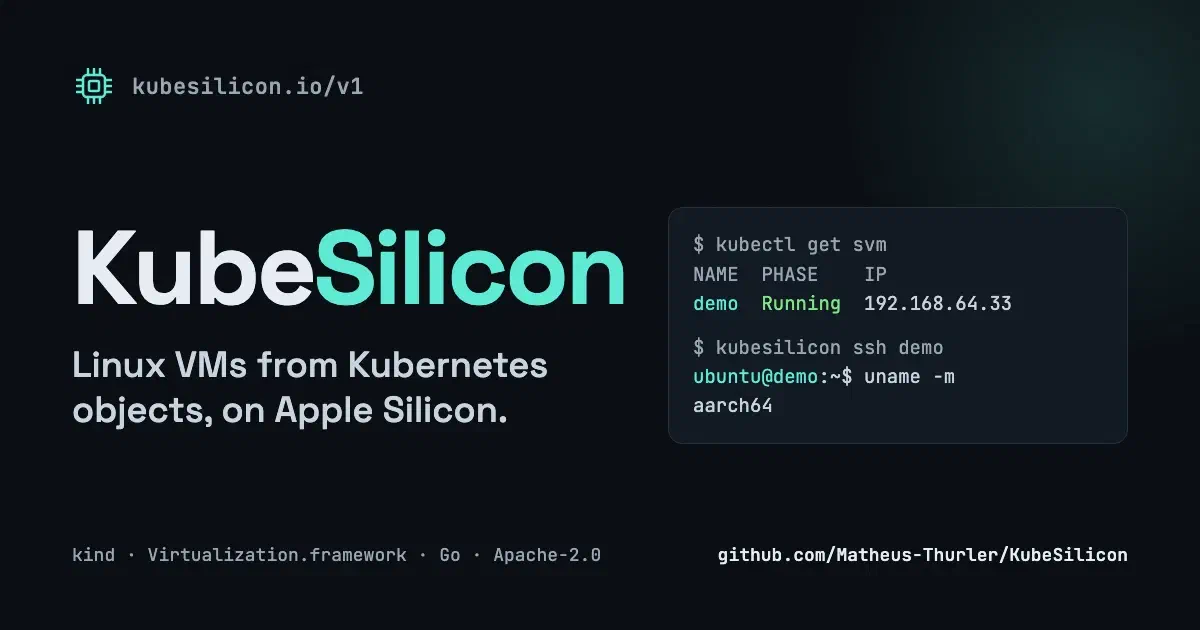
KubeVirt does not run on a Mac with Apple Silicon. It needs KVM, and macOS has no KVM.
I maintain VirtFoundry , a private cloud operator built on KubeVirt. That means every time I wanted to test something that creates VMs, I needed a Linux server. My M5 Pro could run the cluster, but not the VMs.
So I built KubeSilicon
: you declare a SiliconVM object, and a daemon on the Mac boots a Linux ARM64 VM with Apple’s Virtualization.framework
. Pods in your local cluster reach the VM by IP or DNS name.
From-scratch install, 3.5 minutes: kind cluster, install, first VM, SSH, pod to VM, stop/start.
How it works
 kind (Docker Desktop VM)              macOS host
 ┌──────────────────────┐              ┌────────────────────────────────────┐
 │ SiliconVM objects    │◄─ API watch ─┤ kubesilicond                        │
 │ (CRD kubesilicon.io) │── status ───►│   download + convert image          │
 │                      │              │   cloud-init ISO                    │
 │ pod ──────── ping/ssh ─────────────►│   Virtualization.framework  ──► VM  │
 └──────────────────────┘              └────────────────────────────────────┘
The daemon runs on the Mac, outside the cluster. It watches SiliconVM objects, starts one detached process per VM, and writes status.phase and status.ip back. It also publishes a headless Service, so demo.default.svc.cluster.local resolves from any pod. The daemon can stop or crash and the VMs keep running.
Three commands
kind create cluster --name kubesilicon
make install CTX=kind-kubesilicon
kubectl --context kind-kubesilicon apply -f examples/vm.yamlapiVersion: kubesilicon.io/v1
kind: SiliconVM
metadata: { name: demo }
spec:
cpu: 2
memory: 2Gi
disk:
source: https://cloud-images.ubuntu.com/releases/noble/release/ubuntu-24.04-server-cloudimg-arm64.img
size: 10Gi
cloudInit:
userData: |
#cloud-config
users:
- name: ubuntu
sudo: ALL=(ALL) NOPASSWD:ALL
ssh_authorized_keys: [ssh-ed25519 AAAA... you@host]In my tests the VM reaches Running in about 6 seconds once the image is cached, and a busybox pod pings it in 1 to 2 ms.
kind, minikube, and others
The daemon only needs two things: the Kubernetes API of your cluster, and a network path between the pods and the VM (the VMs get a NAT address on the Mac, 192.168.64.x).
- Tested: kind on Docker Desktop. This is the only setup I have validated.
- Should work, not tested: minikube, Colima, OrbStack, k3d. Anything where the cluster runs in a VM or container on the same Mac and can reach that NAT range.
- Does not apply: a cluster in the cloud. The VMs live on your Mac.
If you try another one, tell me what happened. I will add it to the validation notes either way.
How it relates to KubeVirt and VirtFoundry
KubeSilicon is not KubeVirt and does not use its CRDs. It has its own kubesilicon.io/v1 API, shaped like KubeVirt’s, because KubeVirt’s launcher is built around KVM and QEMU.
| KubeVirt | KubeSilicon | |
|---|---|---|
| Hypervisor | KVM + QEMU | Apple Virtualization.framework |
| Where VMs run | Inside pods, on Linux nodes | Processes on the Mac, outside the cluster |
| Guests | Linux, Windows, more | Linux ARM64 only |
| Live migration, hotplug, snapshots | Yes | No |
| Runs on Apple Silicon | No | Yes |
| Maturity | CNCF incubating | Early, one Mac, one maintainer |
KubeVirt is the right choice on Linux servers. KubeSilicon is for the laptop: development, demos, and CI on your own Mac.
VirtFoundry sits one layer above. It gives you tenants, VPCs, IAM, and a UI on top of the hypervisor. Mapping which KubeVirt resources VirtFoundry uses, so it could drive SiliconVM on a Mac, is the idea I want to explore next. It is not built yet.
An honest note on stability
Early on, guests crashed at random: kernel Oops and SIGILL in 3 of 4 boots with Apple’s default disk mode. Switching the disk attachment to cached with fsync gave 0 crashes in 9 boots. The sample is small and I do not know the cause below the framework, so treat it as strong evidence, not proof. The numbers are in docs/validation.md
.
Limits today
- One Mac, one worker. Multiple Macs as nodes is a design goal, not a feature.
- The Service has no ports. Use the VM IP or ping.
- A VM whose launcher process died is not restarted automatically.
- Linux ARM64 guests only. macOS guests are out of scope.
- API
v1in name only. It will change.
Try it
- Repo: github.com/Matheus-Thurler/KubeSilicon , Apache-2.0.
- Needs an Apple Silicon Mac, Go,
qemu-img, a running kind cluster, andkubectl. - Issues and pull requests are welcome, especially reports from other cluster tools.
kubectl get related
| NAME | READY | STATUS | AGE |
|---|---|---|---|
 leaving-proxmox-kubernetes-native-private-cloud I created VirtFoundry: a Kubernetes operator on a path to CNCF Sandbox | 1/1 | Available | 49d |
 nginx-gateway-api-kubernetes Is NGINX Ingress Controller Dead? Meet NGINX Gateway Fabric | 1/1 | Available | 321d |
kubectl get events